
28 Oct 2026
Puffer Loft Is Not the Same as Jacket Weight
Puffer Loft Is Not the Same as Jacket Weight
A puffer can look large without being heavy, and a heavy jacket can have little visible loft. Loft is the space created as insulation expands inside the garment. Total weight includes shell, lining, fasteners and fill.
Read those properties separately. A silhouette with deep padded chambers does not give you a reliable temperature rating or reveal exactly how much filling is inside.
Look at the filled chambers
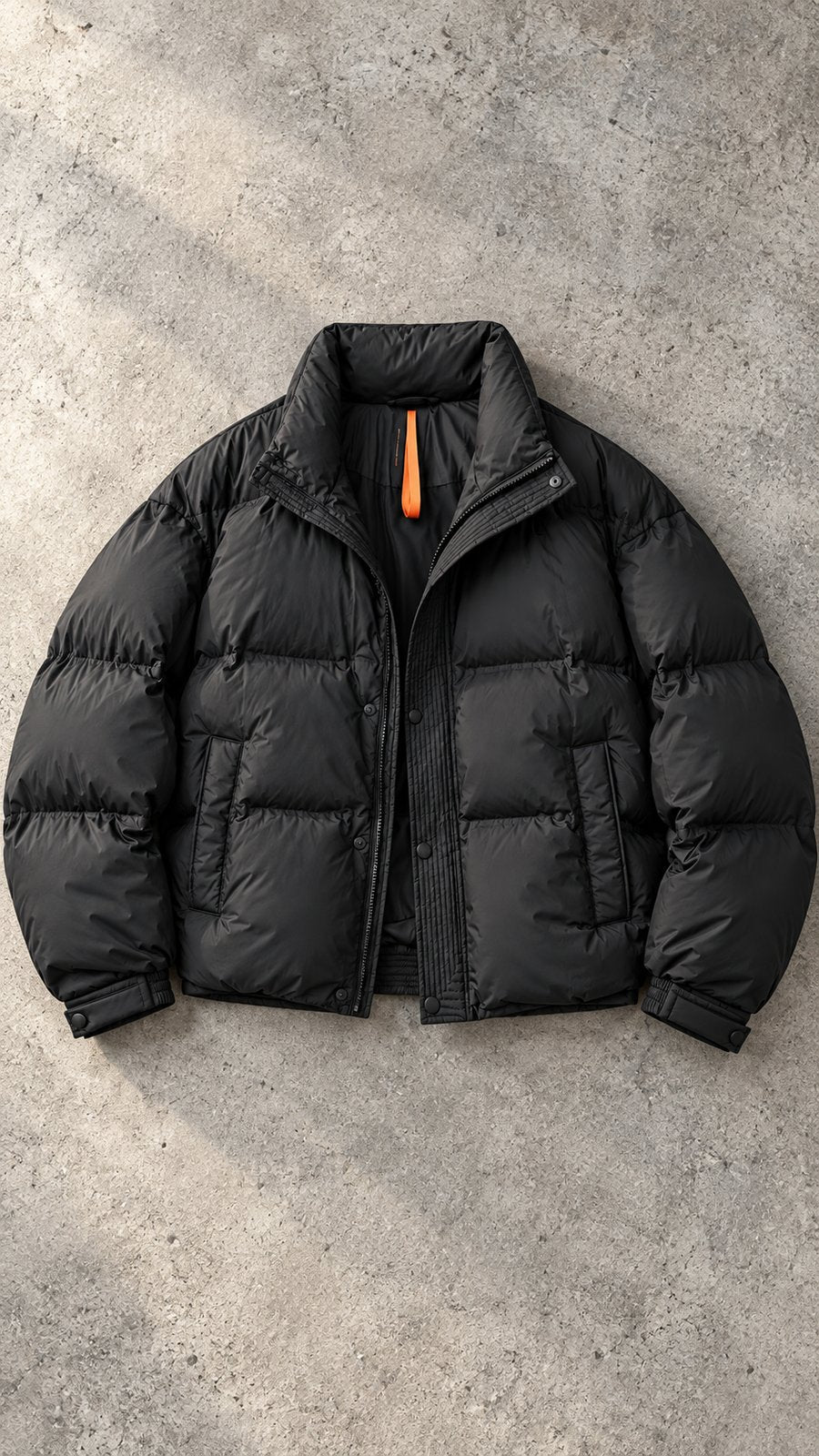
Place the jacket on a flat surface and examine the baffles, the sewn sections that hold insulation. Some rise well above the seams; others remain shallow. The distance between peaks and seams gives a visual clue to loft, though it does not determine the composition or amount of fill.
Turn the jacket and view the same chambers from the side. Photographing a puffer straight on can hide the thickness of its compartments. Compare several areas, including sleeves and shoulders, rather than one full front panel.
Separate fill amount from fill quality
Different insulation systems create loft in different ways. For down, fill power describes how much volume a standard quantity occupies under a defined test. Fill weight describes how much down is used. Those figures are distinct and neither alone tells you how warm a whole jacket will feel.
Do not assume a synthetic-filled garment uses the same specification. Check what the product description actually states. If no measured performance is supplied, describe the construction visually rather than inventing a fill figure.

Consider compression on the body
A padded chamber can flatten beneath a narrow backpack strap or tight outer shell. Compression reduces the air volume that helps provide insulation. Watch the upper arms and shoulders when trying to put another garment over a puffer.
An outer layer can be useful for weather protection, but forcing it over a bulky puffer may remove the room the insulation needs. Compare the puffer jackets category with the jacket range while keeping compression in mind.
See where jacket weight comes from
A heavy front zip, thick fabric face and multiple pockets all add weight. A large jacket uses more shell area than a smaller one. That means a kitchen-scale number for the finished garment cannot tell you whether its insulation is lofty or efficient.
Use hand feel to assess the load on your shoulders and loft inspection to assess visible fullness. They answer different questions. The collar and hem can also contain extra fabric that changes overall mass without warming the central panels much.

Judge the jacket in motion
Wear the puffer closed and lift your arms. Bulky sleeves may contact the torso and restrict movement independently of the jacket's actual mass. Sit down to see whether the front chambers fold comfortably above the waist.
A high-loft look is a design choice as well as a potential insulation feature. Select the amount of volume that allows your normal actions, and do not use visual bulk as a stand-in for a tested warmth claim.
Use a side photograph of a puffer to isolate three measurements: how far the chambers stand out, how long the body hangs and how thick the outer fabric looks. None of these reveals exact insulation weight by itself. A puffer with less overall mass can still hold visible loft. Choose by stated insulation information and movement clearance instead of treating a heavy-feeling jacket as automatically warmer.

Frequently Asked Questions
Does a bigger puffer always contain more insulation?
No. Baffle design, shell volume and the type of fill affect appearance. Check stated specifications rather than estimating from photographs.
Is fill power the same as fill weight?
No. Fill power measures loft under a standard test for down, while fill weight tells you how much down is used.
Why does a puffer flatten under a backpack strap?
Pressure compresses the filled chambers and reduces their thickness. The effect can be temporary or persistent depending on the material.
Can a very light puffer be warm?
It can, depending on insulation, construction, fit and conditions. Total garment weight is not a temperature rating.
Why do puffer sleeves feel bulky when I move?
Filled sleeves occupy space beside the torso and at the elbow. Check their cut and range of motion, not only their weight.
Related reading: Loopback Versus Brushed Fleece: Read the Inner Face and GSM on Clothing Labels: What the Number Actually Measures.